


A shared educational system.
The Law on the Unification of Education brought schools under the Ministry of Education. Education became central to the new republic’s programme of reform.

 PRESENTS
A life that changed a nation.
An idea that looks forward.
01 / A LIFE. A REPUBLIC. A LEGACY.
Soldier, statesman and the first president of the Republic of Türkiye. Explore Atatürk’s life through turning points, archival photographs and the enduring place of education in his vision for a modern nation.
02 / THE FORMATIVE YEARS
A student becomes an officer.
An officer becomes a leader.

Salonica
Mustafa was born in Salonica, then part of the Ottoman Empire and now Thessaloniki in Greece. His education took him from local schools to military classrooms, where a young mind encountered mathematics, languages and a changing world.
Student years, around 1901. Mustafa Kemal is seated second from the left; this is not an 1881 photograph. Archive source
03 / 29 OCTOBER
On 29 October 1923, the Republic of Türkiye was proclaimed. Mustafa Kemal became its first president.
Independence was not the end of the story. The years ahead would reshape the country’s institutions, law, education and public life.
04 / THE POWER OF EDUCATION
The classroom was part of the republic’s transformation.
Knowledge was not an ornament. It was a foundation.

The Law on the Unification of Education brought schools under the Ministry of Education. Education became central to the new republic’s programme of reform.
On 1 November, a Latin-based alphabet was adopted for Turkish. Literacy campaigns and Nation Schools helped adults learn the new letters.
At Universehall, this history resonates with our own purpose: making language and learning more accessible. This is our reflection on the legacy, not a quotation attributed to Atatürk.
05 / A CHANGING PUBLIC LIFE
Women gained the right to vote and stand in national parliamentary elections.
This legislation followed earlier steps in municipal and village elections. It marked a significant expansion of political rights in the republic.
These changes took place in a one-party political system. Understanding the period means recognising both the scale of reform and its historical context.
Explore the parliamentary history ↗
06 / REMEMBRANCE
10 NOVEMBER 1938
Atatürk died at Dolmabahçe Palace in Istanbul.
Each 10 November, Türkiye pauses to remember.
THE UNIVERSEHALL FILM
An English-language cinematic portrait of Atatürk, with English and Turkish subtitles.
THE STORY DOES NOT END WITH REMEMBRANCE.
Anıtkabir became Atatürk’s final resting place on 10 November 1953. Today it is both a place of remembrance and an invitation to engage with the history of the republic.
Return to the beginningREAD BEYOND THE PAGE
Republic of Türkiye · Ministry of Culture and Tourism
↗02 / PARLIAMENTGrand National Assembly of Türkiye
↗03 / FURTHER READINGThe UNESCO Courier · centenary issue
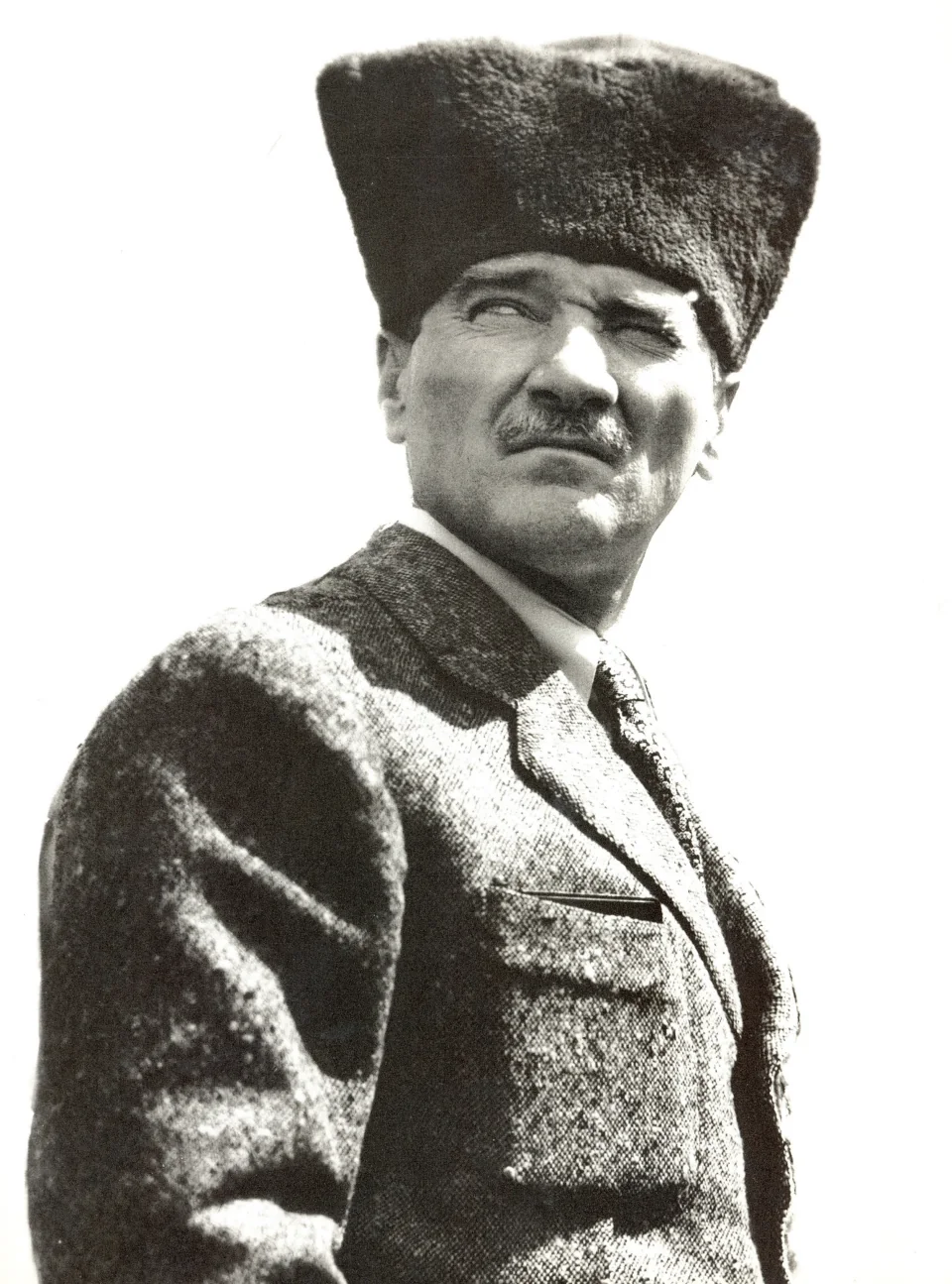
↗Hero portrait: Mustafa Kemal Atatürk, 1923. Public-domain designation on Wikimedia Commons. Resized and compressed for this page; displayed with a soft edge mask.
Remembrance photograph: William Neuheisel, CC BY 2.0. Resized and cropped for this page.
Dates below describe the photographs, not necessarily the selected historical event. The student image accompanies the early-life chapter and was taken around 1901, not in 1881. No historical faces were generated or reconstructed.
This English-language collection uses archival photographs, not AI-generated historical scenes. Editorial headings are original writing, not historical quotations. Images are cropped and resized for presentation.
Motion includes React Bits ScrollReveal and ScrollFloat, by David Haz, under its MIT + Commons Clause license.
Music: Parzival — William Rosati (user-supplied recording). The specific recording licence and off-platform distribution rights have not been verified. Archive rights remain under review.


